

On the Second Sunday after Pentecost, the congregation of Immanuel Lutheran Church in Joplin, Missouri gathered for its first combined summer service and heard a searching question from the prophet Hosea: where is your place? Pastor Christopher Ramstad preached on Hosea 5:15 — “I will return again to my place” — and the Holy Gospel of the calling of Matthew (Matthew 9:9–13), where Jesus seeks out a despised tax collector and declares, “I came not to call the righteous, but sinners.” It is the heart of what this congregation confesses every week — Jesus Brings Life. Meet Him Here.
The Second Sunday after Pentecost: Where Is Your Place?
“Where is your place?” Pastor Ramstad opened the sermon with that simple question. We tend to think about place in terms of location — the spot where the TV remote belongs, where the phone charges overnight, our seat in the pew. But Hosea 5:15 turns the question toward God: “I will return again to my place, until they acknowledge their guilt and seek my face.” Where, in our lives, is God’s place?

Hosea was sent to the northern kingdom of Israel — Ephraim — in the days of King Jeroboam II, to announce that judgment was coming. God painted the covenant as a marriage, and His people as an unfaithful bride who had chased after other gods and other securities: golden calves, false idols, foreign alliances, kings raised up to replace the King of kings. In Hosea 6 the people say the right words: “Come, let us return to the Lord.” But God answers, “Your love is like a morning cloud, like the dew that goes early away.” Their devotion was fleeting — here one moment, gone the next. So God speaks the word that Jesus Himself would later quote: “I desire steadfast love and not sacrifice.”
The sermon pressed the question home. We do the very same thing. We grant God access to an hour on Sunday, a prayer before meals, a devotional minute or two — and then try to keep Him out of the rest: our free time, our hobbies, our finances, our careers, our relationships, the way we parent, the friends we keep. The world around us works to keep God out of identity, marriage, and even life itself. But the God who knit us together in our mother’s womb cannot be compartmentalized or contained. He comes as the Judge of the living and the dead — of all of life, not part of it. The Law of Hosea hews and slays us, calling us to repentance and to seek the Father’s face once more.
“For I desire steadfast love and not sacrifice, the knowledge of God rather than burnt offerings.”
Hosea 6:6 (ESV)
Scripture Readings for the Second Sunday after Pentecost
The lectionary appointed for the Second Sunday after Pentecost (Proper 5, Series A) sets the call to repentance beside the grace that answers it. The Old Testament Reading from Hosea 5:15–6:6 sounds God’s longing for His wayward people and His desire for steadfast love rather than empty sacrifice. The Epistle from Romans 4:13–25 lifts up Abraham, who received the promise “not through the law but through the righteousness of faith,” trusting the God “who gives life to the dead and calls into existence the things that do not exist.” And the Holy Gospel from Matthew 9:9–13 brings us to the tax booth where Jesus calls Matthew, then sits down to eat with tax collectors and sinners — the living picture of the mercy God desires.
Jesus Calls Sinners: The Calling of Matthew
If Hosea shows us the Judge, the Gospel shows us the Savior. Jesus was passing through Capernaum when He saw Matthew — a tax collector, an enemy of his own people, a man working for Rome and lining his own pockets. A wanted man whom nobody wanted. And to him Jesus said, “Follow me.” Matthew rose from the tax booth and followed, and that very evening Jesus reclined at table in his house with tax collectors and sinners. When the Pharisees objected — that is not your place — Jesus answered that the sick, not the healthy, are the ones who need a physician.
“Those who are well have no need of a physician, but those who are sick. Go and learn what this means: ‘I desire mercy, and not sacrifice.’ For I came not to call the righteous, but sinners.”
Matthew 9:12–13 (ESV)
God comes as Judge — but He also comes as the satisfaction for our sins. Jesus took our place at the cross, paying for every sin we have ever committed. When the Father, seated as Judge, looks upon our sin, He sees instead His Son: the shed blood, the steadfast love, the perfection that covers you and me. And where is Jesus found this morning? In an unexpected place — at His table. In the Lord’s Supper He is both host and meal, giving His true body and blood for the forgiveness of sins, as surely as He once ate with Matthew. As Pastor Ramstad put it, Jesus points to this meal and says, look at the price that was paid for you. This love is not a passing cloud or the morning dew; it removes our sin as far as the east is from the west.
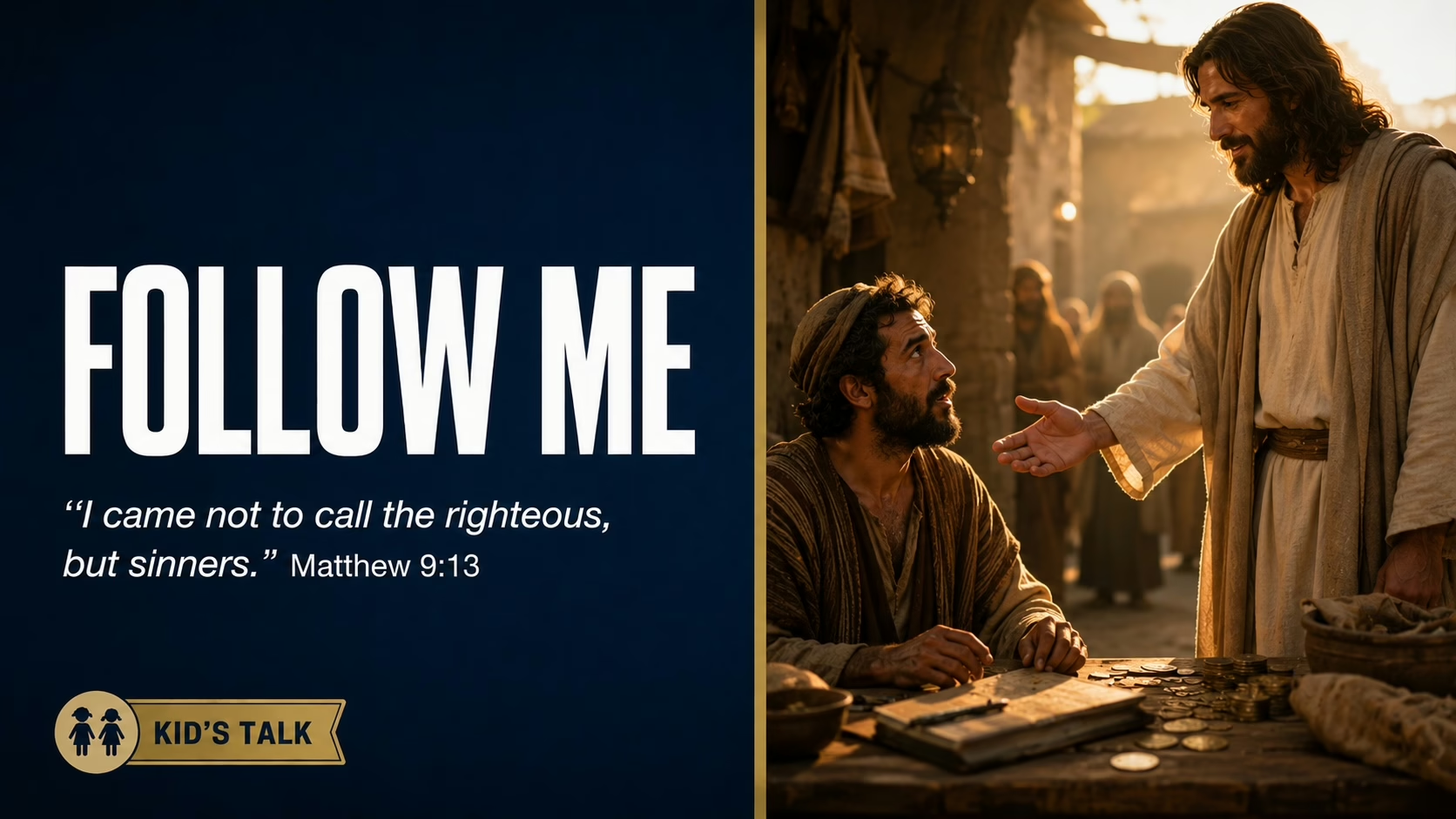
In the children’s message, DCE Jason Glaskey held up a “wanted poster” for Matthew the tax collector — a man nobody wanted as a friend — and showed the children how Jesus chose him anyway. Every person in the pews, he reminded them, is a sinner like Matthew, and Jesus comes for sinners. The congregation had opened the service singing “My Faith Looks Up to Thee” (LSB 702), a fitting prayer for people who know they bring nothing but their need:
My faith looks up to Thee,
Lutheran Service Book 702, “My Faith Looks Up to Thee,” st. 1 — Opening Hymn
Thou Lamb of Calvary, Savior divine!
Now hear me while I pray; take all my guilt away;
O let me from this day be wholly Thine!
This service opened the Season after Pentecost at Immanuel. The Sunday before was the Festival of the Holy Trinity, and the following week continued with the Third Sunday after Pentecost — “while we were still sinners, Christ died for us.” Browse them all in our sermon archive.
☀️ Summer Worship Schedule — One Service at 9:00 AM
Immanuel family and friends: Through the end of August we worship as one congregation at ONE SERVICE, 9:00 AM, with Bible Class and Sunday School following at 10:15 AM. Whether you are a lifelong member or visiting Joplin for the first time, you are warmly welcome. Jesus Brings Life. Meet Him Here.
Frequently Asked Questions About the Second Sunday after Pentecost
What is the Second Sunday after Pentecost?
It is the second Sunday of the long green season that follows the Day of Pentecost — often called the “Time of the Church.” The paraments turn green to signify growth in faith, and the readings walk through the teaching and ministry of Jesus. In the historic three-year lectionary, this Sunday in 2026 is Proper 5, Series A.
Where is the calling of Matthew in the Bible?
It is found in Matthew 9:9–13 (and also recorded in Mark 2 and Luke 5, where he is called Levi). Jesus sees Matthew at his tax booth, says “Follow me,” and then eats with tax collectors and sinners — answering His critics, “I came not to call the righteous, but sinners.”
What did Jesus mean by “I desire mercy, and not sacrifice”?
Jesus was quoting Hosea 6:6, the day’s Old Testament reading. He was teaching the Pharisees that God treasures steadfast love and a true knowledge of Him above mere outward religious acts. Sacrifices and offerings are good, but they mean nothing without faith and love toward the God who gives them.
What does it mean that Jesus came to call sinners?
It means the Gospel is for people who know they need a Savior. Like the physician who goes to the sick, Jesus comes to those broken by sin — which is all of us. He takes our place at the cross, forgives our sin, and gives us new life. No one is too far gone to be called; that is good news for every sinner. Read more about what Lutherans believe →
What time are worship services at Immanuel Lutheran Church in Joplin?
Immanuel worships Sundays at 8:00 and 10:30 AM, with Bible Class and Sunday School at 9:15 between the services. In summer, June through August, we worship at one combined service at 9:00 AM, with Bible Class and Sunday School at 10:15 AM. Visitors are always welcome at 2616 S Connecticut Ave, Joplin, MO 64804.
About Immanuel Lutheran Church, Joplin, Missouri
Immanuel Lutheran Church is a confessional congregation of the Lutheran Church—Missouri Synod (LCMS), located at 2616 S Connecticut Ave, Joplin, MO 64804. We worship in the historic Lutheran liturgy using Lutheran Service Book and hold fast to the Lutheran Confessions as a faithful exposition of Holy Scripture.
Immanuel is home to Martin Luther School, a fully accredited PK–8 Lutheran school. Our youth ministry, Vacation Bible School, LifeLight Bible Study, and other ministries serve the Joplin community year-round. Jesus Brings Life. Meet Him Here.
Browse more sermons and worship services, or contact us to learn more about visiting or joining the Immanuel family.