

Worship Begins With God Serving Us
How Lutherans worship, and why Immanuel worships the way we do
People who visit Immanuel often ask about our worship style. The short answer is that Lutheran worship here is traditional: a sung liturgy from the Lutheran Service Book, hymns led by the organ, three Scripture readings, and a sermon every Sunday. But style is the second question. The first is what worship actually is, and the Lutheran answer may surprise you. If you want a step-by-step walk through a Sunday morning, start with What Happens at a Lutheran Service? This post explains the why behind it.
Visiting this Sunday? Services are at 8:00 and 10:30 a.m. from September through May, and at 9:00 a.m. in the summer. Every word is printed in the bulletin and shown on the screens, so you can follow along from your first visit. For parking and what happens when you arrive, see What to Expect.
What Is Worship? God Serves First
Most of us assume worship is something we give to God: our praise, our attention, our best effort for an hour. Lutherans see it the other way around. Worship begins with God coming to serve us. He speaks His Word, forgives our sins, and feeds us with the body and blood of His Son. Our praise is real and it matters, but it is always an answer to what He has already given.
“For even the Son of Man came not to be served but to serve, and to give his life as a ransom for many.”
Mark 10:45 (ESV)
That is why Lutherans call Sunday worship the Divine Service. The name works both ways at once: God’s service to us, and our service of thanks to Him. The Lutheran Confessions use the very same words. The worship of the law is offering our gifts to God, but “the worship and divine service of the Gospel is to receive from God gifts” (Apology of the Augsburg Confession, Article IV). We come to church empty-handed, and that is exactly how God wants us to come.
Martin Luther said the same thing at the dedication of a new church in Torgau in 1544. He prayed that nothing would happen in that building except that “our dear Lord himself may speak to us through his holy Word,” and that we in turn would speak to Him “through prayer and song of praise.” That is the whole shape of Lutheran worship in one sentence. God speaks and gives. We listen, receive, and answer.
God speaks and gives
His Word, read and preached
Forgiveness, spoken to you in the Absolution
The body and blood of Christ in the Lord’s Supper
We receive and answer
Confession and prayer
Hymns, psalms, and the Creed
Thanks, and a life of service all week long
An old Lutheran hymn puts the same prayer in the worshiper’s mouth:
Speak, O God, and I will hear Thee;
“Open Now Thy Gates of Beauty” — Lutheran Service Book 901, stanza 5
Let Thy will be done indeed.
May I undisturbed draw near Thee
While Thou dost Thy people feed.
Here of life the fountain flows;
Here is balm for all our woes.
Word and Sacrament: Where God Promises to Be
God is everywhere, but He has not promised to forgive sins everywhere. He has attached that promise to specific things: His Word preached and read, Holy Baptism, and the Lord’s Supper. Lutherans call these the means of grace, the means God uses to hand over what Jesus won on the cross. So a Lutheran service is built around them. The readings, the sermon, the font, and the altar are the center of the room and the center of the hour.
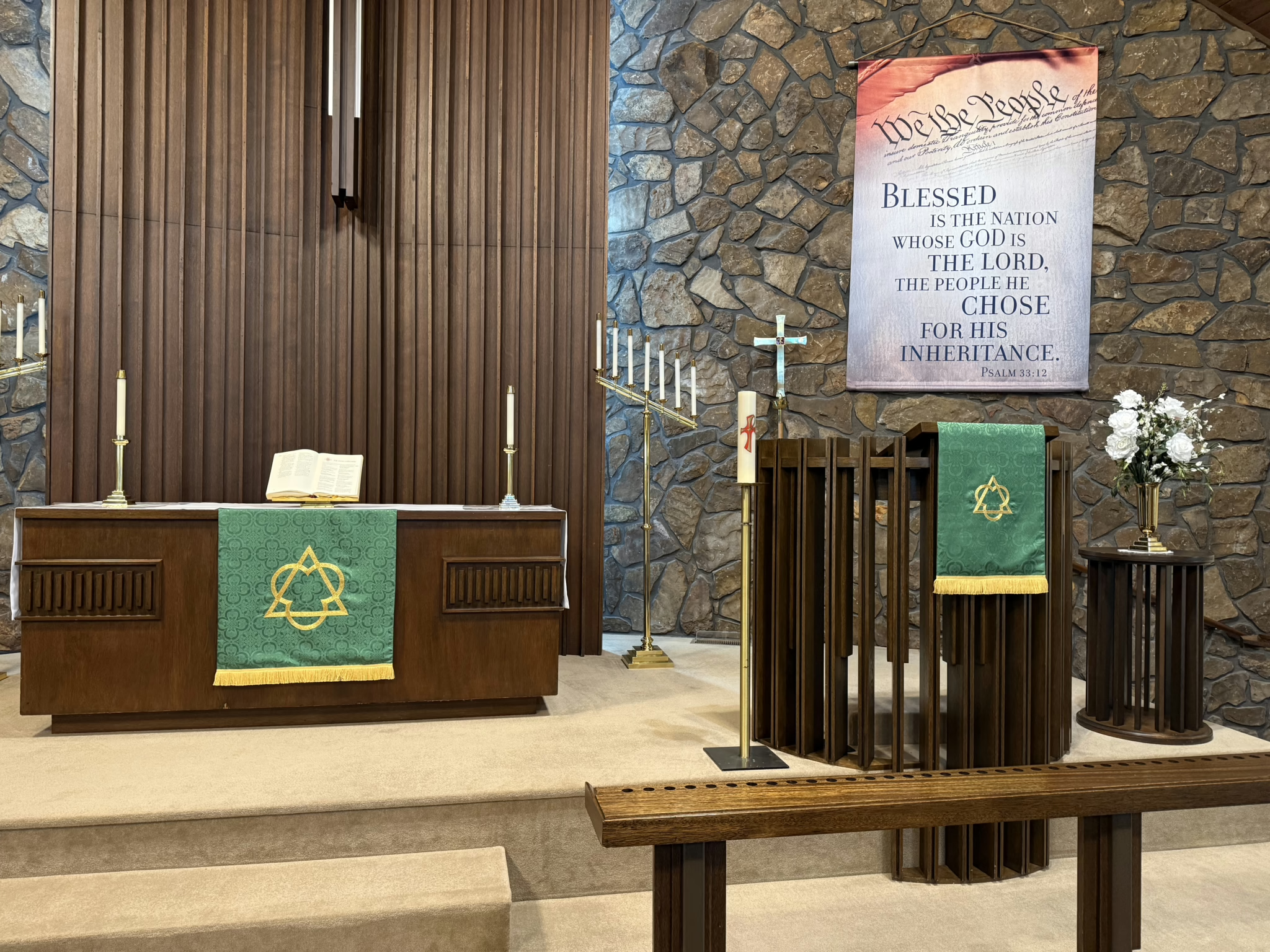
This is also the oldest pattern of Christian worship there is. Right after Pentecost, the first believers “devoted themselves to the apostles’ teaching and the fellowship, to the breaking of bread and the prayers” (Acts 2:42). Teaching, the Supper, and prayer are still the backbone of the service at Immanuel. Holy Communion is celebrated on the first and third Sundays of each month.
Why Lutherans Use a Liturgy
The liturgy is simply the order of the service, the words and songs the congregation shares from week to week. Much of it is Scripture set to music. Four songs of the Divine Service come straight from the Bible:
Gloria in Excelsis
“Glory to God in the highest,” the song of the angels at Bethlehem (Luke 2:14)
Sanctus
“Holy, holy, holy,” the song Isaiah heard around the throne of the King (Isaiah 6:3)
Agnus Dei
“Lamb of God,” John the Baptist pointing to Jesus (John 1:29)
Nunc Dimittis
“A light for revelation,” old Simeon holding the infant Christ, sung after Communion (Luke 2:29–32)
Luther did not invent this service, and he did not throw it away. He kept the historic order of the Western church and removed only what contradicted the Gospel. The Augsburg Confession, the chief statement of Lutheran belief, says our churches keep the Mass and hold it in honor (Article XXIV). When you pray the Kyrie at Immanuel, you are praying words Christians have prayed for well over a thousand years, in hundreds of languages, in every kind of building.
The liturgy also does something quieter. Because the words stay the same, you learn them. Children who cannot read yet sing the Kyrie. People with dementia often still pray the Lord’s Prayer when much else is gone. The service does not depend on a gifted leader or a good mood that morning. It keeps Christ at the center whether the week has been a good one or a hard one.
Our Monthly Pattern of Services
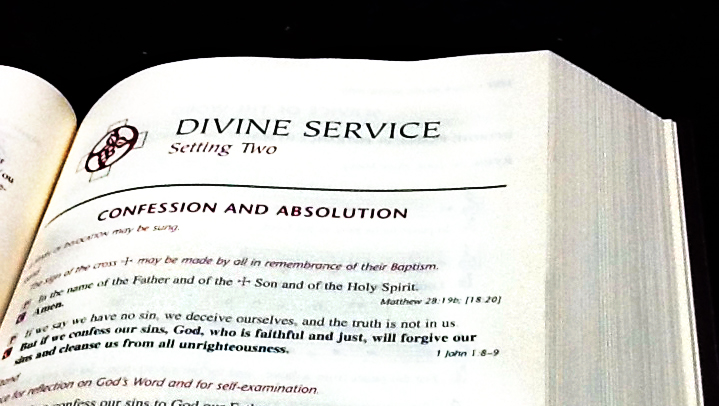
The Lutheran Service Book contains several orders of service. Each has its own music, but they all share the same shape. Immanuel rotates through them on a monthly pattern, so the congregation learns each one well without singing the same music every week. Holy Communion falls on the first and third Sundays. Festivals and special Sundays sometimes change the pattern.
Divine Service, Setting One · LSB page 151
Holy CommunionService of Prayer and Preaching · LSB page 260
Service of the WordDivine Service, Setting Three · LSB page 184
Holy CommunionDivine Service, Setting Four · LSB page 203
Service of the WordMatins, the historic morning service · LSB page 219
Service of the WordThe page numbers are for the red hymnal in the pew rack. Some people like to follow along in the book, and it is a good way to learn the service at home. Wondering whether this Sunday is a Communion Sunday? Our church calendar shows every service.
What About Worship Style?
Here is something many people do not expect: Scripture does not command an organ, a hymnal, or any one style of music. The Augsburg Confession says the true unity of the church does not require that human ceremonies be the same everywhere (Article VII). Lutherans call these matters adiaphora, things neither commanded nor forbidden. Some LCMS congregations offer a contemporary service, and Christians of good faith worship in many different ways.
So why does Immanuel keep a traditional service? Freedom is not the same as indifference. What we sing week after week shapes what we believe, so the words matter more than the sound. Lutheran hymns are known for carrying real teaching: sin and grace, the cross and the empty tomb, Baptism and the Supper, all in one hymn. St. Paul describes this kind of singing when he asks us to let “the word of Christ dwell in you richly, teaching and admonishing one another” in psalms, hymns, and spiritual songs (Colossians 3:16).
The five we have sung most
God’s Own Child, I Gladly Say It LSB 594
A Mighty Fortress Is Our God LSB 656
When Peace, like a River LSB 763
At the Lamb’s High Feast We Sing LSB 633
Alleluia! Sing to Jesus LSB 821
The organ serves the same goal. Its job is to lead a room full of people in singing, so the congregation is the choir and nobody is the audience. And the historic liturgy joins us to Christians across the world and across the centuries, which is what we confess in the Nicene Creed: “one holy Christian and apostolic Church.”
Coming from a church with a praise band? You are welcome here. Your first Sunday may feel unfamiliar, and that is completely normal. You do not need to know anything ahead of time, and within a few Sundays it starts to feel like home. Have a question first? Pastor Ramstad would love to hear from you.
The Church Year: Walking Through the Life of Christ
Lutheran worship follows the church year, a calendar that retells the story of Jesus every twelve months. The first half follows His life: Advent and Christmas, Epiphany, Lent, Holy Week and Good Friday, Easter, and Pentecost. The second half, the long green season after Pentecost, follows His teaching and the life of the church.
The 2026–27 church year at Immanuel
52 Sundays, shown by season and by the color on the altar
You can see the season from the pew. The paraments (the cloths on the altar and pulpit) change color with it. At Immanuel, Advent is blue, Lent is purple, the seasons after Epiphany and Pentecost are green, the festivals of Christ are white, and Pentecost is red. The readings follow a three-year lectionary, a set list of Scripture passages shared by Lutheran congregations. Over three years we hear the whole sweep of the Bible, not only the preacher’s favorite texts.
Worship Is for the Whole Family
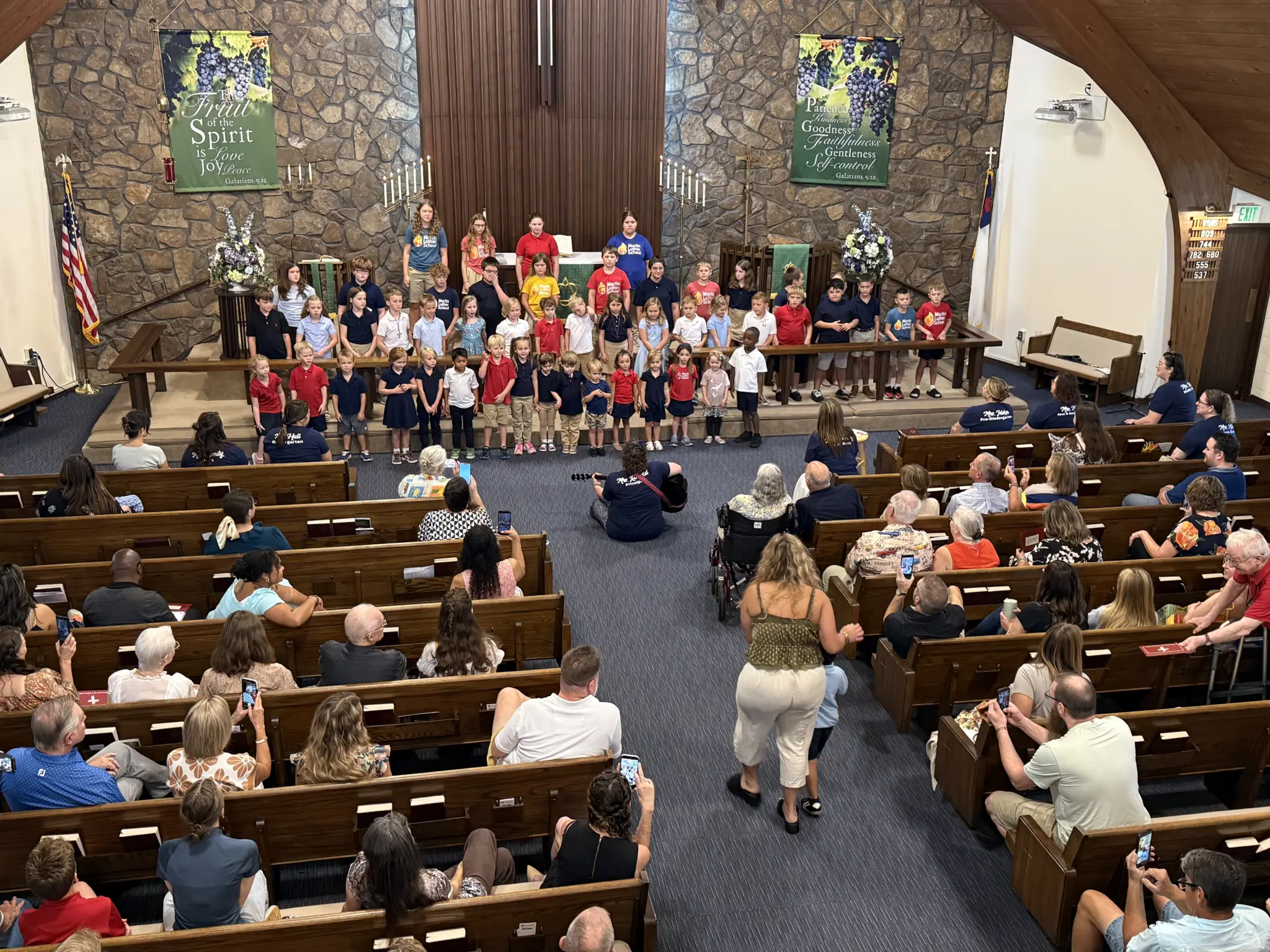
Children are not just allowed in worship at Immanuel. They are encouraged in it, because God’s gifts are for them too. Every service includes a short Kids Talk, and the wiggling and noise that come with young children do not bother anyone. Students at Martin Luther School also gather in the same sanctuary for chapel on Wednesday mornings during the school year. They learn the liturgy young, and it stays with them.
Worship Does Not End at the Door
The Divine Service ends with a blessing and a sending. Paul calls the whole Christian life “your spiritual worship” (Romans 12:1), and Lutherans take that seriously. Changing diapers, running a register, grading papers, and caring for an aging parent are all ways of serving the neighbor God has given you. Sunday is where we are forgiven and fed for that work. Monday is where the work happens.
Luther’s Small Catechism explains the Third Commandment this way: “We should fear and love God so that we do not despise preaching and His Word, but hold it sacred and gladly hear and learn it.” You can read the full Small Catechism free online. For worship at home, our family devotion resources are a good place to start, and the LCMS worship pages go deeper.
Come and Worship With Us
The best way to understand Lutheran worship is to be there. You are welcome any Sunday, whether you grew up Lutheran, come from another church, or have never been to church at all.
September through May: 8:00 and 10:30 a.m., Christian Education Hour at 9:15
June through August: one service at 9:00 a.m.
2616 S Connecticut Ave, Joplin, Missouri 64804
You can also see our Sunday service times, read What We Believe, or listen to recent sermons in our sermon archive. Questions are welcome too. Reach out to Pastor Ramstad any time.
For our members: when a friend or neighbor asks what worship is like at Immanuel, send them this page. Then invite them to sit with you on Sunday.
Frequently Asked Questions About Lutheran Worship
What is the Divine Service?
It is the Lutheran name for the main Sunday service. The name means God is the one serving. He speaks His Word and gives His Sacraments. We receive His gifts and answer with prayer and praise.
Does Immanuel have a contemporary service?
Our Sunday services are traditional. We sing the liturgy and hymns from the Lutheran Service Book, led by the organ. The section above on worship style explains why.
Is Lutheran worship like Catholic worship?
The two share the same ancient order of service, so they can look alike. The difference is in what the service teaches. Lutherans confess that we are saved by grace alone, through faith alone, in Christ alone. Luther kept the historic order and removed what conflicted with that teaching. Lutherans also receive both the bread and the wine in Holy Communion.
Do I need to know the liturgy before I come?
No. Everything you need is in the bulletin and on the screens. Sit, stand, and sing as much as you are comfortable with. Nobody is watching to see if you get it right. See What Happens at a Lutheran Service? for a walk through each part.
Why does the service change with the seasons?
Lutherans follow the church year. It retells the life of Christ every year, from Advent to Pentecost. The readings, hymns, and altar colors change with each season. The shape of the service stays the same.
Immanuel Lutheran Church, 2616 S Connecticut Ave, Joplin, MO 64804, is a congregation of the Lutheran Church—Missouri Synod. Related reading: What Is Lutheran Confirmation? and Who Is Jesus?